
A Realistic Timeline for Perfume Bottle Decoration
The printing itself is the fastest part of decorating a perfume bottle; everything around it is slow. Proofs, tooling, a pilot run, curing and inspection each add their own cycle, and together they set the calendar far more than the press does. A realistic plan treats the approval steps as the schedule and the printing days as the noise around it — and a brand that books the approvals first is the one that ships on time.
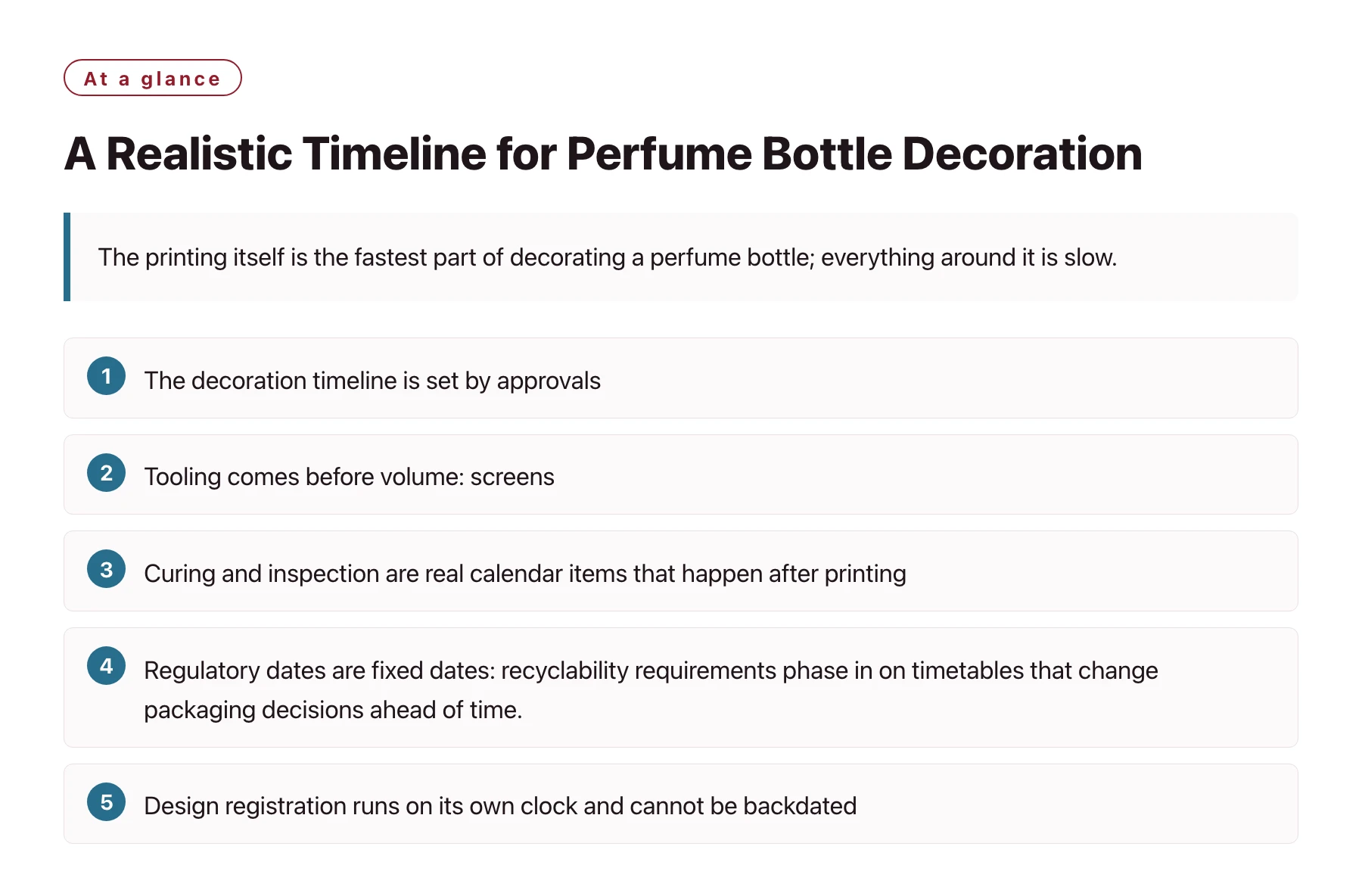
Key takeaways
- The decoration timeline is set by approvals, not production: every proof round, pilot run and re-run adds a full cycle.
- Tooling comes before volume: screens, foils and coating masks are made for the artwork and cannot be rushed.
- Curing and inspection are real calendar items that happen after printing, and they only exist in the plan if someone writes them in.
- Regulatory dates are fixed dates: recyclability requirements phase in on timetables that change packaging decisions ahead of time.
- Design registration runs on its own clock and cannot be backdated, so the bottle design is filed as soon as it is final.
Every new brand asks the same question: how long will the bottle take? The honest answer is that the bottle was never the question — the decoration is, and decoration time is approval time.
The timeline below reflects a normal project: no disasters, but no miracles either. Its purpose is to show where the weeks genuinely go, so the launch plan can be built around them instead of discovering them.
The stages that set the calendar
- Freeze artwork and identityLogo, colours and label text approved in writing. Every change after this point reopens a previous stage.
- Draw the placementThe print area drawn on the actual bottle shape and agreed with the decorator before tooling starts.
- Build the toolingScreens, foils or coating masks are made to order for the artwork; the first fixed date in the project.
- Proof on real glassPhysical samples with the real ink or foil; expect at least one revision round before acceptance.
- Approve the first articleThe first bottle at final settings is checked, signed and retained as the reference by both sides.
- Run the pilot batchA small run at production settings reveals alignment, adhesion and curing problems before the large order.
- Cure, inspect and retainDrying or curing time, then QC against the reference; the retained sample becomes the standard for the line.
- Release to volumeFull production using the pilot's settings, followed by packing and shipping.
Where the weeks actually go
Proofing is a loop, not a milestone
Few artworks pass the first proof: colour on glass differs from the screen, foil behaves differently on the curve, and white sits differently on frosted blanks. Plan for two rounds as the norm and write the second round into the schedule; the extra cycle costs a week, and it costs nothing more if the schedule admitted it from the start.
Curing happens after printing
Ink and coatings need drying or curing time before they can be handled, inspected and packed. This is calendar that has nothing to do with the printing press, and it only appears in the plan if someone writes it in — which makes it one of the most common hidden delays in the whole project.
Regulatory dates are fixed dates
Packaging requirements in the EU are phasing in on defined timetables, so recyclability and design-for-recycling decisions carry deadlines [1]. For a brand launching a decorated line, the phase-in dates are as real as the printing schedule: they decide which finishes are still sensible in which launch year.
Design protection has its own clock
If the bottle is a protectable asset, the design registration runs on a separate calendar, measured through national filing or the international route administered by WIPO [2]. Registration cannot be backdated to the launch, so the application should go in as soon as the final artwork and shape exist — not when a copy of the bottle appears on a marketplace.
Building the decoration into the master plan
The decoration schedule runs in parallel with the fragrance: while the juice rests and is tested, the glass, proofing and tooling advance on their own track. The two tracks meet only at filling, which is why a single shared timeline for both usually underestimates one of them.
Book the decoration milestones first — artwork freeze, first proof, pilot — and let production follow. When the milestones are dates with owners, the project manages itself; when they are aspirations, the launch date is whatever the last approval makes it. A house like Xuelei Fragrance that runs glass, decoration and filling on one calendar manages the whole chain internally; a brand coordinating separate suppliers manages the interface itself.
Add one protective habit to the calendar: ask every supplier for their decoration stage list at the first meeting and multiply each approval by the number of revision rounds you normally need. The number that comes out is the real lead time — and it is usually the one worth planning with.
The factory's calendar is part of your calendar
The bottle schedule is only half of the equation: the factory's overall production capacity and lead times production capacity and lead times decide when the pilot and the volume run can be slotted in at all. The capacity question deserves to be asked in the same conversation as the decoration question, because the answers interact — a factory that is fully booked in your launch month will quietly move both the tooling and the proofs.
Sources
- European Commission: Packaging Waste and the PPWR —— EU rules on packaging and packaging waste, including the Packaging and Packaging Waste Regulation requirements on recyclability and design.
- WIPO — World Intellectual Property Organization —— The UN agency for intellectual property; resources on industrial design and patent protection relevant to product and packaging design.
Frequently asked questions
How many weeks should a new brand budget for decoration?
Budget around the approval loops rather than a fixed number: two proof rounds, a pilot and their corrections are the realistic baseline, and the printing itself is a small part of it. Ask the factory for its stage list, then multiply each approval by the revision rounds you normally need.
What is the first fixed date in a decoration project?
Tooling. Screens, foils and coating masks are made to order for the artwork, so the artwork-freeze date is the first one with real consequences. Everything before it can still move; most things after it cannot.
Can decoration be compressed to hit a launch date?
Only by cutting approval steps, which moves the risk into the launch itself — colour drift, adhesion failures or a pilot skipped at full volume. Compressing the schedule is possible; compressing the risk is not.
Why do regulatory dates belong in a decoration timeline?
Because packaging rules phase in on fixed timetables and change which finishes can still be used after a given date. A finish that is fine today may force a redesign next year, so the phase-in schedule belongs in the same plan as the proofs.
When should I file the bottle design?
As soon as the final artwork and shape exist, because registration runs on its own calendar and cannot be backdated. If the design is part of the brand's value, file before launch — not after a copy appears on the market.